
Get a personalized walkthrough of ThriveNumber™ from a member of our team.


.svg)
A fervent believer in the promise of human powered growth, Russ leads CMG in partnering with companies to help them become aligned, agile, customer-driven enterprises that unleash the potential of their organizations with sustainable improvements in focus, teams, culture, and process our clients.
Mark leads CMG in partnering with Telecom companies to help them increase customers and accelerate revenue. His 25+ years of experience in growth, strategy and execution includes B2C and B2B multi-channel acquisition programs, customer experiences that surprise and delight, pricing that optimizes customer value, and innovative product development.
Blog by Kim Scribner
The truth is, even if your customers NEVER step foot inside your office building or manufacturing plant, they will feel how your organization is designed.
If there are break downs in communication inside your organization, it will show up in the place’s customers feel friction most: the awkward handoff from sales to onboarding, the support agent who can’t touch billing, the returns process that bounces between teams, the product that feels like three different apps stitched together.
That’s Conway’s Law in the wild: systems tend to mirror the communication structures of the organizations that build them. In practice, your customer experience becomes a reflection of your team boundaries—especially where work crosses those boundaries.
The moment the org chart becomes the experience
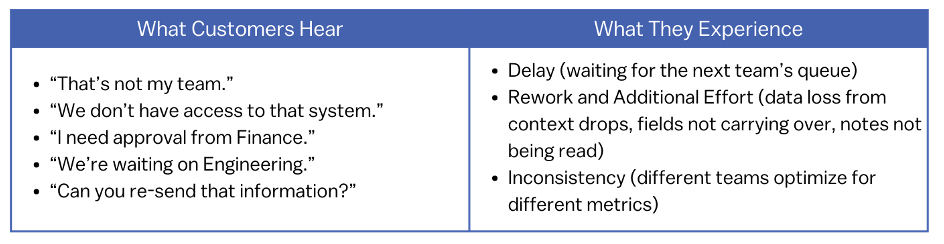
Most customer pain isn’t caused by one bad decision. It’s most often caused by handoffs. Internally, handoffs are “coordination.”Externally, they feel like: confusion, repetition, and indifference.
1. The “Three Portals” product
Customers have separate logins or wildly different UI patterns for related tasks (e.g., ordering vs. billing vs. reporting). That’s usually not a design choice—it’s three teams shipping independently with limited alignment. This is sometimes the result of organizations that have grown through acquisition.
Customer sentiment: “Why does it work one way here and a totally different way there?”
Org root cause: Multiple product/engineering groups with separate backlogs, separate release trains, separate definitions of“done.”
What you may notice: Customer service hired their own engineers because they couldn’t get prioritized time from the software development team.
2. The “Sales → Implementation” Cliff
The customer’s expectations are set by Sales, then the first post-signature interaction feels like a restart. The sentiment of discovery notes throughout the sales cycle don’t make it to the implementation team, so implementation starts from scratch. Support doesn’t know the promised configuration.
Customer sentiment: “Why am I explaining this again?”
Org root cause: Handoff between teams optimized for different outcomes, where sales is measured on close rate, and implementation teams are measured on time to go live.
What you may notice: Discovery happens twice for professional services engagements.
3. The “Policy pinball machine”
Customers bounce between service reps who all follow scripts, and often cannot make exceptions. The process is rigid even when the customer’s case is reasonable.
Customer sentiment: “No one can help me, but everyone is polite.”
Org root cause: Decision making isn’t the responsibility of the frontline team, and they may not own resolution. Policies are determined elsewhere – risk, legal, finance – where there’s little or no expertise in customer service.
What you may notices: The server at a restaurant“explaining” instead of apologizing for a poor experience, unable to make it right based on policy
4. The “Queue”
Work sits in queues - intake queue → triage queue → specialist queue → approvals → delivery. Customers experience it as “stuck,”with no reliable timeline.
Customer symptom: “It’s been two weeks—what’s happening?”
Org root cause: Each function is responsible for their specific queue, and functional queues have sequential dependencies.There’s no clear end-to-end owner, working from the customers perspective.
What you may notice: Hierarchies lead to the “boss’s boss” approval chain, causing customer delays.
Handoffs are expensive, and also typically invisible internally. Inside the organization, they look efficient –each specialist handles what they’re good at, work is standardized, and leaders can measure utilization. You’ll often hear things like “we stay in our lane,”or “I don’t want to step on that teams’ toes.”
Customers, however, don’t care about lanes. They care about outcomes. And these hidden costs can lead to coordination load, taking time away of serving customers in impactful ways. Inside the organization these also lead to inefficiency, which may include an excess of status updates, meeting and rework.
If the customer journey crosses five teams, the experience will often feel like five companies.
1. Pick a Customer Journey
Begin with the customer journey that drives the most revenue (or the most complaints). This may be new customer onboarding, claims processing, renewals, returns/refunds.
2. Map the Journey (3 Layers)
Layer 1: Customer Steps – what actions is the customer taking along the journey
Layer 2: Internal Steps – what actions do those inside the organization take
Layer 3: Ownership & Systems –what teams, tools, SLAs and decision makers are involved at each step
3. Identify Opportunities
Find each step where there is a handoff, waiting queue, re-entry of data or approval. These are your ConwayHotspots to be evaluated.
We know that if we try to focus on everything, we might as well do nothing. You’ll also likely find yourself in a restructure debate. Here’s some ways to get started.
1. Redesign ownership before you redesign the org chart
Start by assigning an end-to-end owner for the journey (or a meaningful segment of it). Not a committee. Not “shared.” One accountable leader with authority to refine the user experience. Yes, they may need to partner with leaders in other functions, but ownership of the experience means they will think meaningfully about the choices they are making.
What you’ll see immediately:
A good test: If the onboarding experience breaks, can one person be held accountable for fixing it?
2. Redesign the handoffs (make them fewer, cleaner, and explicit)
It’s nearly impossible to run an organization with zero handoffs. Making those handoffs purposeful is the goal. You’ll want to replace fuzzy transitions with clear entry/exit criteria, a single source of truth, and defined SLAs.
Quick win: Create a “handoff checklist” that travels with the work in the workflow tool, not in someone’s inbox or as a static document.
3. Define or refine decision rights
Many customer frustrations come from “I’m not allowed to do that.” Design decision rights so the frontline can actually resolve issues.Define (1) what the frontline can decide (2) what requires escalation (3)thresholds – dollar value, risk level, specific policies (4) the escalation path.
This is where experience often improves fastest—because it reduces back-and-forth loops.
Measure It: Track the % of cases resolved without escalation and time-to-decision.
4. Redesign the work around the customer journey (not internal functions)
If a journey is strategically important, consider a cross-functional pod (or “team of teams”) aligned to that journey. The goal isn’t to duplicate specialists everywhere, but to ensure there’s a team that can deliver outcomes without constant negotiation and minimize dependencies. This also allows for customer feedback to reach delivery teams more quickly.
Most companies can make meaningful progress without a formal restructure. You’re not trying to re-build a perfect organization, you’re trying to reduce customer effort and delay where it matters.
Your customers don’t experience your departments. They experience the seams between them. Conway’s Law isn’t a warning that your org structure is “wrong.” It’s a reminder that your customers will feel the cracks, whether you intend it or not.
If the customer experience feels fragmented, don’t start with a reorg. Start with:


