
Not What — But Why, When, and How (Much)
A Practical Approach to Focus and Impact
Blog by Kim Scribner

“I need a brochure”
Most marketing teams recognize this unmotivating moment immediately. Requests that show up as solutions are a trap. They may feel fast and concrete, but they can keep us busy while missing the actual purpose or outcome.
It’s so easy to jump straight into execution, but the “what trap” can send teams down a path of doing an endless number of things, without knowing why we’re doing them. As marketing teams, we don’t often struggle with a lack of ideas, we struggle with everything feeling urgent.
Creating an eye for impact
So how do teams and organizations ensure they know what to do now, what to defer, what to stop—and how to right-size effort so we drive real outcomes? They practice ruthless prioritization.
Ruthless prioritization is the discipline of creating clarity on the why, who, when, and how so strategy turns into impactful action, not just a frenzy of activity. And, this shouldn’t take a lot of time. We’re talking about a pause, not a halt or bottleneck.
Having a prioritization filter that teams use consistently is a practical approach to bringing clarity at a speed that matches market pace.
Ruthless Prioritization Filter (In Under 5 Minutes)
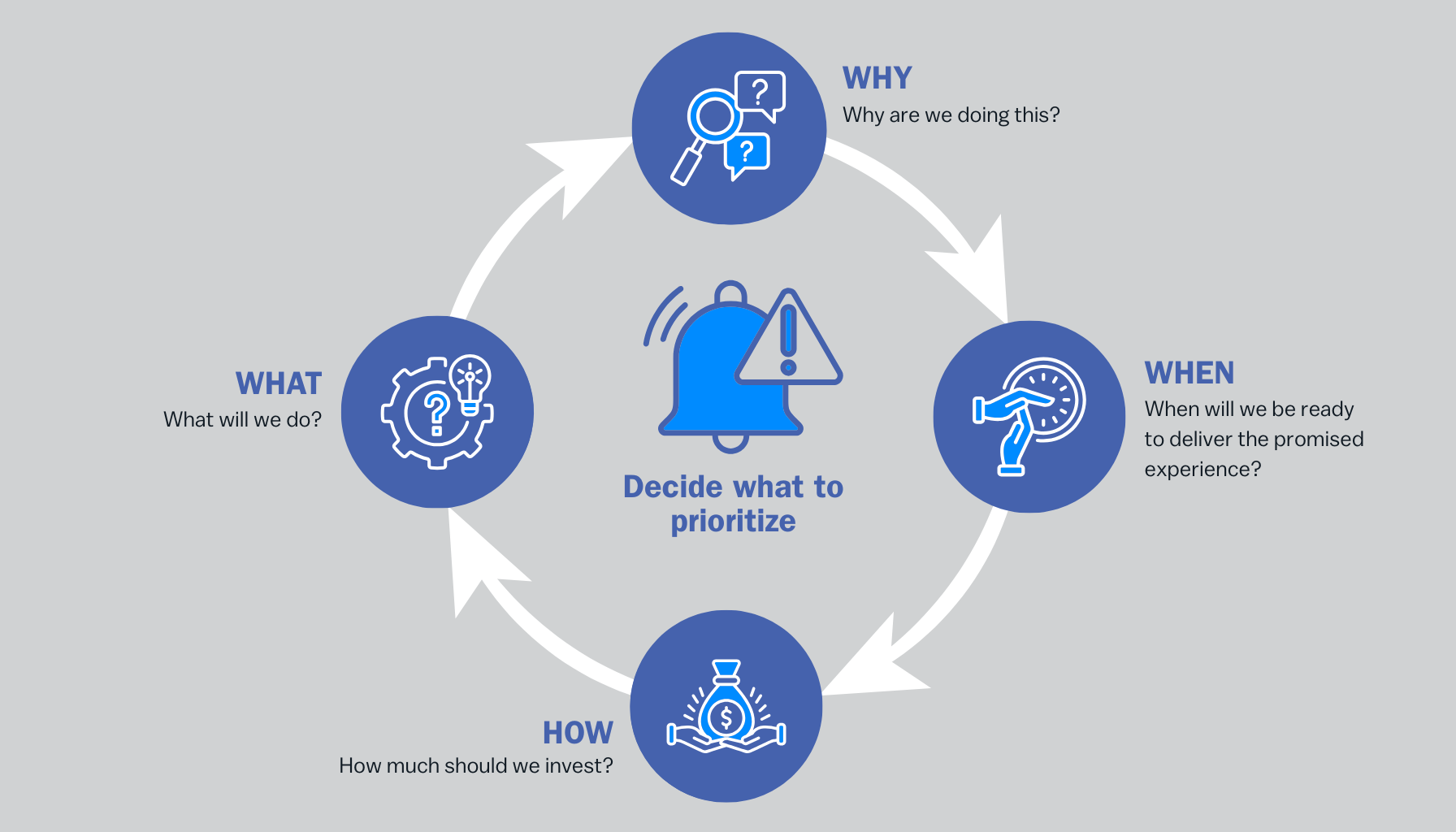
Prioritization filters clarify why, who and when so teams can right-size effort and make better decisions before work begins. The criteria outlined below can be used on any solution-shaped request before work begins.
WHY (and for WHO) are we doing this?
Outcomes over outputs
One of the strongest “focus moves” teams can make it refusing solution-shaped problem statements. Pulling back to the real problem can be challenging, but once a solution is written into the request, teams often stop seeing better options.
Try this (5 minutes, no workshop required):
Who is this for (customer, patient, employee, partner)?
What outcome must change (conversion, cycle time, retention, quality, cost)?
What’s our hypothesis of impact (how will this create value)?
What evidence do we have (data, research, customer input)?
Your problem statement may look something like, “How might we [improve outcome] for [who] given [constraint]?”
WHEN should we do it?
Sequencing and readiness
Timing isn’t a project-management detail: it’s a strategy decision.
If we aren’t strategic about our marketing plans, we could wind up “marketing disappointment.” An example of this may be creating demand for a service or product the team can’t fulfill. Our when must include thinking from the audience’s perspective about capacity, experience, supply, readiness. Without those, growth turns into frustration and potential brand damage.
Some key “when” questions:
Are we ready to deliver the experience we’re about to promise?
What dependencies must be true first (capacity, process, training, tooling)?
What can we learn with a small test before scaling?
When sequencing aligns withy readiness, growth strengthens rather than frustrates customers.
HOW much should we invest?
Right-size effort to impact
Ruthless prioritization isn’t just about picking the right work, it’s about investing the right amount of effort.
We’ve all heard about gold-plated projects, where everything is included before we even test to see if we’re directionally improving the customer’s problem. That’s often an over-investment relative to the outcome we expect.
Additionally, there’s a hidden cost of doing too many things, forcing constant task switching, stealing time from deep work and reducing impact even when the team is “busy.”
A practical way to calibrate investment:
High uncertainty: run a minimum viable test (learn fast, spend small).
Medium uncertainty: iterate (build–measure–learn) until the path is clear.
Low uncertainty: standardize and scale (systems, cadence, measurement).
As we think about maximizing impact, we must consider how we leverage time, energy, and money.
WHAT will we do?
Only after clarifying why, for whom and how much effort should teams decide on the ‘what'. This is where the design thinking mindset matters most, because it keeps prioritization from turning into a static spreadsheet exercise.
A few principles to apply immediately:
Focus on human values: anchor decisions in who you serve.
Show, don’t tell: prototype the idea instead of debating it.
Embrace experimentation: treat work as learning loops, not one-shot bets.
Craft clarity: make the problem, decision, and success measures easy to repeat.
Radical collaboration: include the people closest to the work and the customer.
Bias toward action: decide, test, learn, adjust.
Over time, prioritization becomes embedded in how teams operate, rather than a separate exercise.
Coaching Tip: Make trade-offs visible
The hardest part of prioritization is saying “no” without creating chaos. The only way around this is to make trade-offs explicit—if we take this on, we delay or end those projects—no heroics. If we value delivered well, we must make choices.
Are you building focus—or just producing work?
If your roadmap is full but impact is fuzzy, try these questions:
Are we measuring outcomes or counting outputs?
Are we clear on who we’re serving, or are we defaulting to internal urgency?
Are we sequencing work based on readiness (so we don’t create disappointment)?
Are we right-sizing investment or giving the gold standard to every request?
FAQs
What is ruthless prioritization?
Ruthless prioritization is the discipline of making clear trade-offs so your organization focuses on the few initiatives most likely to drive meaningful outcomes. It’s not about doing more with less—it’s about doing the right things, at the right time, with the right level of effort and high quality. This is done by filtering work through why it matters, when it should happen, and how much investment it deserves before committing to the “what.”
What is a problem statement?
A clear description of a specific issue, pain point or gap, for a specific audience. The problem statement concisely details the current state and desired future state from the end user’s perspective. Your problem statement should include the specific audience, relevant data points and why it’s a problem.
Example: As a customer calling XYZ customer service, I often wait on hold for more than 5 mins, making it more challenging to get a solution to my problem.
What’s the difference between outputs and outcomes (and why does it matter)?
Outputs are the things you produce (a campaign, a feature, a deck, a brochure).
Outcomes are the measurable changes you’re trying to create (higher conversion, shorter cycle time, fewer defects, improved retention).
It matters because outputs can keep teams busy while outcomes stay flat. When you prioritize outcomes first, the right outputs become clearer, and teams can right-size effort, test sooner, and deliver work that actually moves the needle.
