
How can CMOs use AI?
The following post was written using AI (artificial intelligence) and is representative of the efficiency you can gain through new tools and technology.

Chief Marketing Officers (CMOs) can leverage artificial intelligence (AI) in several ways to enhance their marketing efforts. Here are some key areas where CMOs can utilize AI:
Data analysis and customer insights: AI can process and analyze large volumes of customer data to derive meaningful insights. CMOs can use AI-powered analytics tools to understand customer behavior, preferences, and trends. This information helps in creating more targeted marketing campaigns and personalized customer experiences.
Predictive analytics: AI can help CMOs predict customer behavior and anticipate market trends. By analyzing historical data, AI algorithms can provide insights into future customer needs and preferences. This enables CMOs to make data-driven decisions, optimize marketing strategies, and allocate resources effectively.
Content creation and curation: AI can assist in generating and curating content. CMOs can use AI-powered tools to create personalized content at scale, such as customized email campaigns, product recommendations, or social media posts. AI can also help curate relevant content from various sources, saving time and effort in content curation processes.
Chatbots and virtual assistants: CMOs can leverage AI-powered chatbots and virtual assistants to enhance customer service and engagement. These automated systems can handle routine customer queries, provide product recommendations, and offer personalized support. Chatbots can also gather customer data, providing valuable insights to CMOs.
Marketing automation: AI can streamline marketing operations by automating repetitive tasks, such as email marketing, lead scoring, and campaign optimization. CMOs can utilize AI-powered marketing automation platforms to target the right audience, deliver personalized content, and track campaign performance in real-time.
Customer segmentation and targeting: AI can assist in segmenting customers based on their characteristics, behaviors, and preferences. CMOs can utilize AI algorithms to identify distinct customer segments and develop tailored marketing strategies for each group. This enables more effective targeting and personalization of marketing campaigns.
Social media monitoring and sentiment analysis: AI can help CMOs monitor social media platforms and analyze customer sentiments. AI algorithms can sift through vast amounts of social media data, identify trends, and measure brand sentiment. CMOs can gain valuable insights into customer opinions, gauge the effectiveness of marketing campaigns, and respond to customer feedback promptly.
Voice and image recognition: CMOs can leverage AI-powered voice and image recognition technologies to enhance customer experiences. Voice assistants and image recognition systems can enable seamless interactions, allowing customers to search for products, make purchases, or get personalized recommendations using voice commands or visual inputs.
It's important for CMOs to assess their specific business needs, evaluate available AI technologies, and implement AI solutions that align with their marketing goals and strategies. Additionally, data privacy and ethical considerations should be taken into account when using AI for marketing purposes.
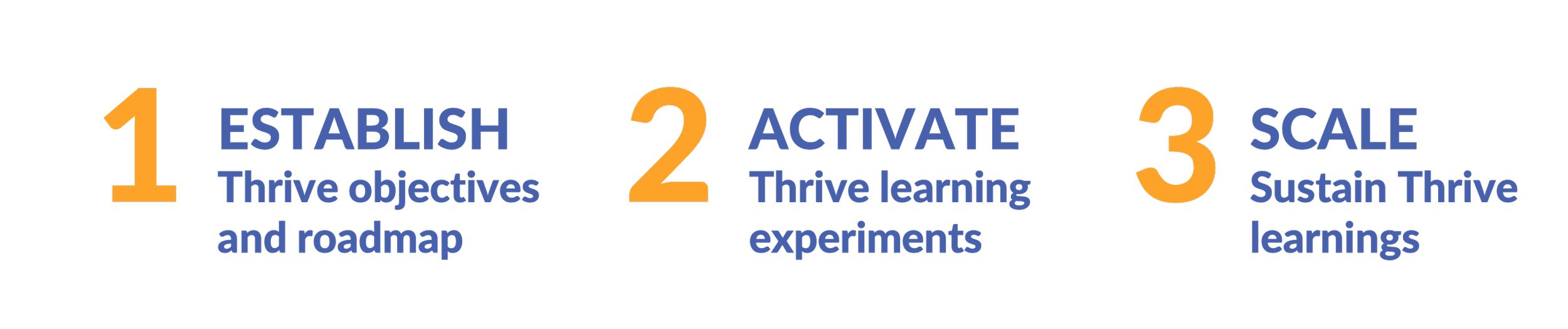
It provides the focus, capabilities, and bias for change required to achieve mission-critical customer goals.
A Brief Overview of ThriveNumber
Key to ThriveNumber is the recognition that while every enterprise is different, internal alignment is critical to achieving desired outcomes. The need to excel at setting and executing strategy in rapidly changing times requires proactively assessing and fostering internal alignment. Organizations that fulfill both these needs effectively and efficiently are better at repeatedly converting effort into progress. This ongoing journey of delivering on strategy and embracing change is a fundamental advantage as capabilities, conditions, environments, and destinations continually evolve.
ThriveNumber begins by establishing a pragmatic baseline of the enterprise’s current state. Through a simple set of questions, distilled from CMG’s decades of experience helping enterprises transform and thrive, executive leadership teams and their direct reports reflect on six key drivers of market success plus the organization’s propensity to change, including:
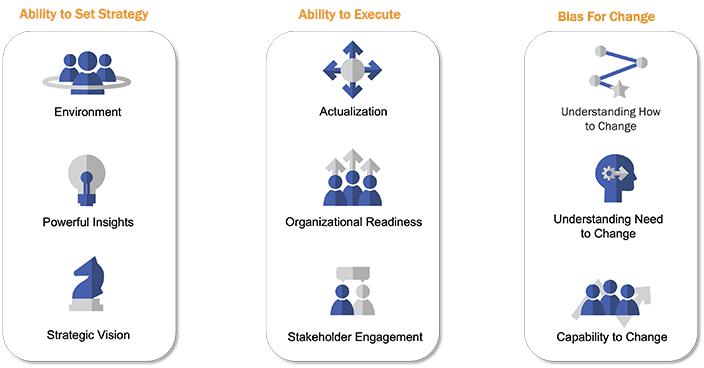
The reflections on these organizational success drivers and their contributing strengths are captured via a quick 15-minute survey. CMG’s custom analytics produce multiple views of the organization that enable alignment, action, and improvement. Specifically, ThriveNumber provides leadership teams and their organizations with the identification of:
The presence of 30 strengths required for customer-driven market success, as perceived by a leadership team and their direct reports.
The degree of alignment (or not) among leadership on perceived strengths.
The degree of alignment (or not) among leadership on perceived challenges.
The organization’s self-perception of its propensity to change.
Implicit or explicit risks and opportunities in achieving the organization’s customer-driven strategic goals, based on reported success drivers and strengths.

These insights equip leadership teams and their organizations to convert effort into transformative progress. Using traditional discovery and diagnosis approaches, such insights historically require four to six months of effort and six-to-seven-figure financial investments with a limited record of success. Using ThriveNumber, the financial investment in discovery is significantly reduced and the wall-time for the effort can be dropped to six weeks or less. The culmination of this phase is a single-day leadership workshop to evaluate the insights, gain alignment, and commit to action.
ThriveNumber provides a change leadership methodology that organizes, orchestrates, and optimizes its improvement work over time. By periodically renewing the assessment of ThriveNumber success drivers and strengths, leadership can enhance both the transparency and honesty needed to engineer an escape from the trap of “effort without progress” for the enterprise.
Five Real-World ThriveNumber Use Cases
While ThriveNumber can be adopted by C-suite leaders and their enterprises to address a wide variety of challenges and opportunities, five of the most common use cases are
Focusing Leadership and the Broader Organization on the Right Things. Misalignment on organizational strengths and challenges will hamstring any strategic initiative and undermine the pursuit of transformation. ThriveNumber allows for hidden differences of perspective to be made explicit and debated. Ultimately, leadership alignment is an accelerant to any change agenda, so the clarity of purpose brokered at the start of the transformation is a rallying flag for the broader organization.
Accelerating and/or De-risking Achievement of Annual and Long-term Plan Objectives. The scale, speed, and complexity of a modern enterprise frequently result in doubts about achievement of annual plans. ThriveNumber helps leaders balance objectives and organizational capability, improving the enterprise’s ability to effectively set and execute strategy. This balance makes outcomes more predictable and sidesteps “effort without progress” traps. With the squeezed timeframe of an annual plan, improvement initiatives need to show results and payback quickly enough to positively impact goal achievement, reducing reliance on improbable end-of-year heroics.
Optimizing Performance in the Face of Recessionary Headwinds. Whatever the cause, in periods of resource scarcity (whether money, people, or time), leaders and their teams need to remove organizational friction quickly and consistently to achieve their goals. Misalignment, missing or underutilized strengths, and inability to rapidly change all sap the enterprise’s ability to “do more with less.” ThriveNumber economically zeros in on the sources of these issues so they can be resolved, and better progress made.
Improving Employee Engagement. It’s hard for employees to be engaged and effective when they’re exhausted. While ongoing digitalization may offload some of their work, too many team members feel they are caught in the “effort without progress” trap. Their path to escape the trap is hidden, exacerbating frustrations. ThriveNumber, used effectively and supported by change leadership, can increase employee fulfillment while the drive company performance.
Improving Organizational Readiness. Amid the third decade of the 21st century, many of our organizations remain stuck in 20th century behaviors, yet to be fully ready for current and future realities. Our human sensibilities can interfere with today’s needs for effective and efficient cross-functional teams, rich in expertise of innovative experimentation and possessing a relentless drive to improve outcomes. In environments where complexity and scale rule, ThriveNumber provides insights needed for the ongoing orchestration and optimization of these teams, their ways of working, and their outcome objectives.
Moving Forward
It is easy to feel that the only realistic path forward is to hunker down and tough out the challenges. Many leadership teams hope, somehow, this time the organization will miraculously break out of the “effort without results” trap.
Leaders rationalize that improvement “right now” is not really a possibility. They will project that the organization just needs to survive this (whatever this is) and then might consider doing things differently. Right now, there is too much to do, too little funding, and little time to make meaningful changes. Further, the questions are asked, “How much would really change? How would we ever get everyone to agree on what needs to change?” Deep down, leadership may even feel the enterprise is too broken to think about thriving.
This organizational reality is why ThriveNumber exists. It provides leaders and their organizations with the path to better outcomes. Starting with a pragmatic and effective way to escape from their “effort without progress” trap. It does not depend on perfect conditions, just leadership’s commitment to get started. ThriveNumber generates a clear-eyed view of the organization's current state, which leaders and their teams can utilize to tailor a plan to progress towards a thriving future. The plan will be pragmatic, iterative, agile, believable, and suitable to the particulars of any specific enterprise.
To learn about how your organization can evaluate and adopt ThriveNumber to escape your “effort without progress” trap, visit our dedicated ThriveNumber page and schedule a demo today.
