
Growth Is Always Human-Led
Blog by Kim Scribner

Most leaders can describe growth in clean, mechanical terms:
Acquire more customers
Retain customers
Increase transaction size or frequency
Launch a new product
Improve the user experience
But that’s not the whole story. Growth is a kind of change. And change doesn’t “happen” to an organization the way a new dashboard gets installed. Change is lived—in meetings people avoid, in the tradeoffs they make, in what gets praised and what gets ignored. Over time, those moments quietly define what’s actually valued and rewarded.
That’s why the road to growth is still sometimes met with obstacles. Not in the slide deck. In the system.
Compliance is NOT Commitment: That’s The Real Fault Line
Here’s a familiar scenario:
Leadership announces a growth initiative. The organization nods. Workstreams form. The decks get updated and multiply. Activity increases. Then...progress stalls.
It’s tempting to label that resistance. But often, it’s something subtler: compliance without commitment. People can comply with something they don’t fully understand. They can comply with something they quietly disagree with. They can comply while assuming it will pass.
Compliance creates motion. Commitment creates progress.
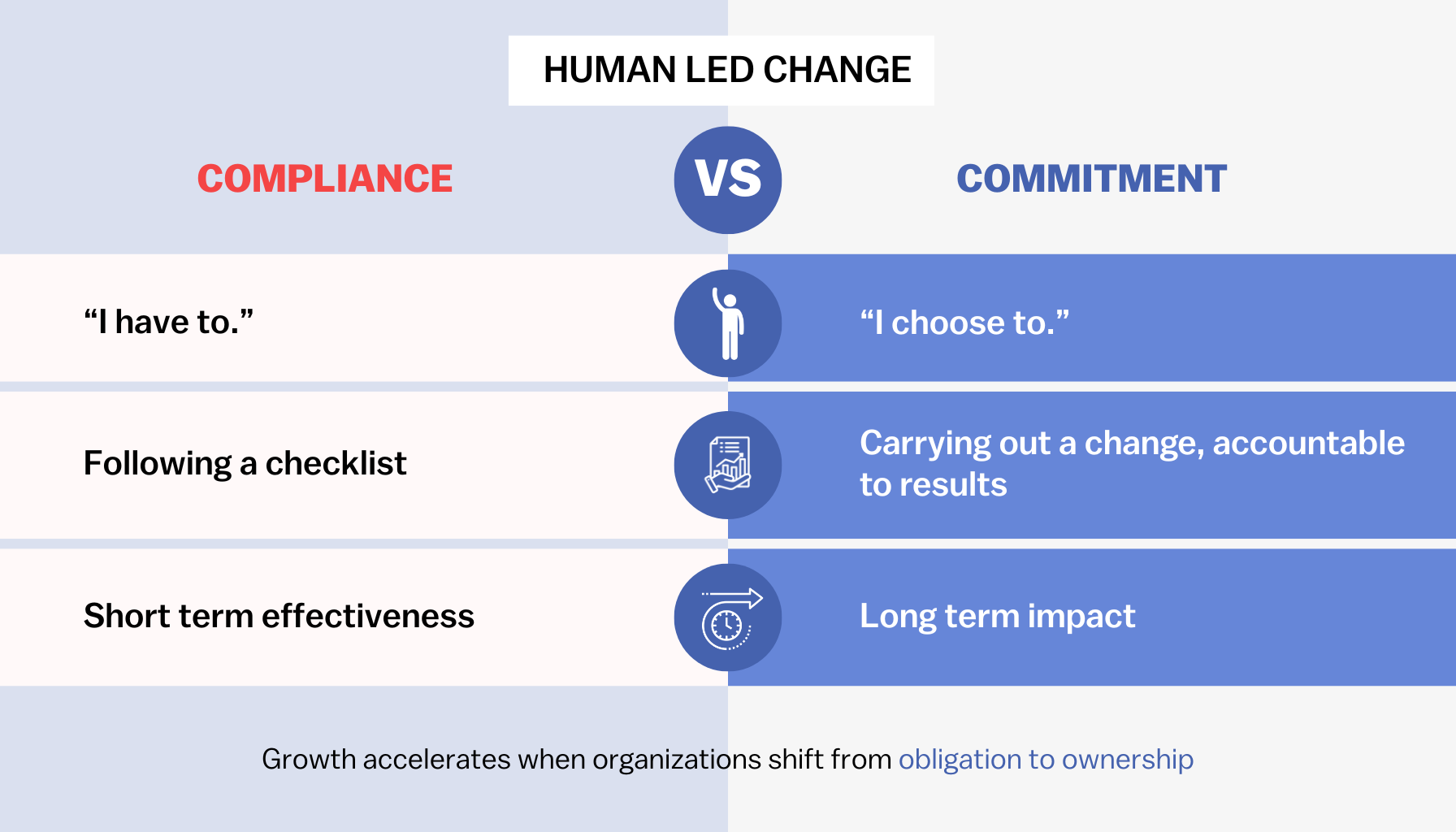
You won’t get sustainable growth through compliance. You get it through choice because change is a choice, not a directive. The job of leadership isn’t to demand agreement. It’s to create the conditions where people can make a meaningful choice to move with you...even if they’re not thrilled about it yet.
“Why” Is a Growth Capability
Can your team explain why change is necessary? Do they understand the reason for growth?
When change struggles, it’s usually not because people don’t know what to do. It’s because they don’t know why they’re doing it. There’s a practical way to pressure-test whether change will stick: ask someone a few layers down in the organization to explain the reason behind the initiative.
Not the “what we’re doing.”
Not the “timeline.”
Not the “new process.”
The why.
When the “why” is fuzzy, people fill the gap with fear, cynicism, or assumptions. When the “why” is clear, even skeptics will give change a chance. As a leader in an organization, if you do ONE thing, be clear about the why.
Clarity isn’t a messaging exercise. It’s infrastructure. Without it, growth sits on shaky ground.
Human Led Change – Leader Pro Tips
Don’t Avoid Your Skeptics. Recruit them
Most leaders want “change champions.” Yes. Get them.Also, find your greatest skeptic early. The person who raises their hand and asks the uncomfortable question. The person who sees the potholes before you hit them. Many leaders sidestep that person in the name of momentum. That’s a mistake.
Skeptics are early warning systems. When you treat that person like a partner and trusted early advisor, you don’t just get better execution. You get more legitimacy.
Ask them “Help me find what I’m missing”
Silence is Not Agreement.
Sometimes the most passionate people in the room go quiet because they’ve learned their voice doesn’t matter. That’s not buy-in. That’s disengagement. And it’s a leading indicator that your change will move slower than your strategy assumes.Leaders who pay attention to silence, who ask what isn’t being said, tend to catch problems earlier.
Intent vs. Impact: The Hidden Accelerator
Most leaders don’t intend to create friction. But intent isn’t what your organization runs on. Impact is. This is where “human-led” gets very real.
The higher you go in an organization, the more weight your words carry. A throwaway comment can become a policy overnight. A “quick question” can land like an indictment.
Human-led change requires leaders to build a reflex:What did I mean? (intent)
How did it land? (impact)
What does it unlock or shut down next?
Be Consistent: Model the Actions You Want to See.
Growth initiatives don’t fail because people can’t execute. They fail because the organization is executing two different rulebooks at once:The one leaders say they want
The one the system actually rewards
The Point
Growth strategies are necessary. But growth is ultimately carried out by people making decisions in moments you don’t see. In how they respond to pressure. In whether to speak up. In whether they believe this change is real. If you want your organization to evolve (new products, new experiences, new capabilities, new markets) start where change actually happens:
in behavior
in trust
in clarity
and in the choices people make when nobody is watching
Change and growth are always human-led.
